|
|||||||
The Large Rocket
Small Rocket
Many schools operate a science week within which is often a rocket day. Youtube
These rockets are often purchased from proprietary model manufacturers.
However the technology behind the rockets is relatively simple. You will still have to buy the chemical rocket motors as the manufacture of these items is heavily regulated. Boxford LTD accepts no responsibility for any use or misuse of the information held here you must make your own risk assessments and adjust the project accordingly. You can easily find a selection of suppliers by clicking these links (Estes Industries or Quest Aerospace ) The rest of the rocket is a matter of engineering and manufacture. The first rockets designed were based on 50mm x 600mm postal tubes. The nose cone was manufactured out of blue polystyrene foam.
Nose Cone Boxford Lathe File - Download The motor holder comes in two sizes depending on the motor you buy. Small Standard Motor - Download Large Standard Motor - Download Motors come in a number of sizes and have a coding system on the side.
Blackpowder motors come in impulse ranges from 1/8A to E, although a few F blackpowders motors have been made. The physically largest blackpowder model rocket motors are typically E-class, for black powder is very brittle. If a large black powder motor is dropped, or is exposed to many heating/cooling cycles (for example, in a closed vehicle exposed to high heat), the propellant charge may develop hairline fractures. These fractures increase the surface area of the propellant, so that when the motor is ignited, the propellant burns much more quickly than it should, producing greater than normal internal chamber pressure inside the engine. This pressure may exceed the strength of the paper case, causing the motor to burst. A bursting motor can cause damage to the model rocket ranging from a simple ruptured motor tube or body tube to the violent ejection (and occasionally ignition) of the recovery system. Rocket motors with power ratings higher than D to E, therefore, customarily use composite propellants made of ammonium perchlorate, potassium nitrate, aluminium powder, and a rubbery binder substance contained in a hard plastic case. This type of propellant is similar to that used in the solid rocket boosters of the space shuttle and is not as fragile as black powder, increasing motor reliability and resistance to fractures in the propellant. These motors range in impulse from size D to O. Composite motors produce more impulse per unit weight (specific impulse) than do black powder motors. Reloadable composite-propellant motors are also available. These are commercially-produced motors requiring the user to assemble propellant grains, o-rings and washers (to contain the expanding gases), delay grains and ejection charges into special non-shattering aluminium motor casings with screw-on or snap-in ends (closures). The advantage of a reloadable motor is the cost: firstly, because the main casing is reusable, reloads cost significantly less than single-use motors of the same impulse. Secondly, assembly of larger composite engines is labor-intensive and difficult to automate; off-loading this task on the consumer results in a cost savings. Reloadable motors are available from D through O class. Motor nomenclature
Rocket motors. From left, 13mm A10-0T, 18mm C6-7, 24mm D12-5, 24mm E9-4, 29mm G40-10.
Model rocket motors produced by companies like Estes Industries and Quest Aerospace are stamped with a code (such as A10-3T or B6-4) that indicates several things about the motor. The Quest Micro Maxx engines are the smallest at a diameter of 6mm. The company Apogee Components made 10.5mm micro motors, but those were discontinued in 2001. Estes manufactures size "T" (Tiny) motors that are 13 mm in diameter by 45 mm long, while standard A, B and C motors are 18 mm in diameter by 70 mm long. Larger C, D, and E class black powder motors are also available; they are 24 mm in diameter and either 70 (C and D motors) or 95 mm long (E motors). Some motors, such as F and G single-use motors, are 29mm in diameter. High-power motors (usually reloadable) are available in 38mm, 54mm, 75mm, and 98mm diameters. First letterThe letter at the beginning of the code indicates the motor's total impulse range (commonly measured in newton-seconds). Each letter in successive alphabetical order has up to twice the impulse of the letter preceding it. This does not mean that a given "C" motor has twice the total impulse of a given "B" motor, only that C motors are in the 5.01-10.0 N-s range while "B" motors are in the 2.51-5.0 N-S range. The designations "1/4 A" and "1/2 A" are also used. For a more complete discussion of the letter codes, see Model rocket motor classification. For instance, a B6-4 motor from Estes-Cox Corporation has a total impulse rating of 5.0 N-s. A C6-3 motor from Quest Aerospace has a total impulse of 8.5 N-s. First numberThe number that comes after the letter indicates the motor's average thrust, measured in newtons. A higher thrust will result in higher liftoff acceleration, and can be used to launch a heavier model. Within the same letter class, a higher average thrust also implies a shorter burn time (e.g., a B4 motor will burn longer than a B6). Last numberThe last number is the delay in seconds between the end of the thrust phase and ignition of the ejection charge. Black Powder Motors that end in a zero have no delay or ejection charge. Such motors are typically used as first-stage motors in multistage rockets as the lack of delay element and cap permit burning material to burst forward and ignite an upper-stage motor. A "P" indicates that the motor is "plugged". In this case, there is no ejection charge, but a cap is in place. A plugged motor is used in rockets which do not need to deploy a standard recovery system such as small rockets which tumble or R/C glider rockets. Plugged motors are also used in larger rockets, where electronic altimeters or timers are used to trigger the deployment of the recovery system. Reloadable motors
Reloadable motor cases. From left: 24/40, 29/40-120, 29/60, 29/100, 29/180, 29/240
Reloadable motors are specified in the same manner as model rocket single-use motors as described above. However, they have an additional designation which specifies both the diameter and maximum total impulse of the motor casing in the form of diameter/impulse. A reload designed for a 29mm diameter case with a maximum total impulse of 60 newton-seconds carries the designation 29/60 in addition to its impulse specification. Motors are electrically ignited with an electric match consisting of a short length of pyrogen-coated nichrome, copper, or aluminium bridgewire pushed into the nozzle and held in place with flameproof wadding, a rubber band, a plastic plug or masking tape. On top of the propellant is a tracking delay charge which produces smoke but essentially no thrust as the rocket slows down and arcs over. When the delay charge has burned through, it ignites an ejection charge, which is used to deploy the recovery system. Quest have also designed a makit yourself skyscope - Download The technical term for the Quest Skyscope is "inclinometer" - we call sometimes just call it an "altitude measurer". Either way, it's an awesome tool for estimating the altitude of static and flying objects. With the Skyscope Inclinometer you don't need to use a plastic protractor and string - everything is built in! This project will enable you to be able to estimate the height of static (buildings) or flying objects by simple "direct read" or by using "tangent calculation". There is a series of instructions on how to use the inclinometer. - Download With a series of student worksheets - Download Models are normally made with a single cord holding the whole thing together. Using a system known as Nose-blow recovery. This is where the ejection charge of the motor ejects the nose cone of the rocket (usually attached by a shock cord made of rubber, Kevlar string or another type of cord) from the body tube, destroying the rocket's aerodynamic profile, causing highly-increased drag, and reducing the rocket's airspeed to a safe rate for landing. Nose-blow recovery is generally only suitable for very light rockets. Parachute/Streamer
A typical hassle with parachute recovery.
The approach used most often in small model rockets, but can be used with larger rocket models given the size of the parachute greatly increases with the size of the rocket. It uses the ejection charge of the motor to deploy, or push out, the parachute or streamer. Typically, a ball or mass of fireproof paper or material is inserted into the body before the parachute or streamer. This allows the ejection charge to propel the fire-proof material, parachute, and nose cone without damaging the recovery equipment. Air resistance slows the rocket's fall, ending in a smooth, controlled and gentle landing. Model Rocket Safety Code
The large rocket was designed based on 50mm x 600mm postal tubes. Whilst the small rocket was based on the A3 postal tubes. 23mm x 300mm tubes. The nose cone was manufactured out of blue polystyrene foam.
Large Nose Cone Boxford Lathe File - Download Small Nose Cone Boxford Lathe Files - Download The motor holder comes in two sizes depending on the motor you buy. Small Standard Motor - Download Large Standard Motor - Download The parachute or drone is made form a bin liner (Get the cheap thin ones). Cut a single bin liner into six squares. Using a glue gun and two pieces of 1m long string, glue the string diagonally across the corners). (Shock cord or kevlar string would be a good safety precaution if the string breaks or melts the rocket may return to the ground with speed).
Whole Chute
Attach the sting to the top of the motor housing.
The attach the wire retaining clip to the rocket motor housing (Stops motor falling back out on launch pad.)
Thread the wire through the tube and push the motor housing home.
Attach the Nose Cone. Fire proof wadding may be a better safety precaution (Available from Rocket Motor Suppliers).
Then push some wadding (Paper Towel) down the tube. This is to help stop the heat melting the chute as the motor pops the nose cone off.
Finally tie the chute to the shock cord. and fold and insert it into the tube end then fit the nose cone with all the loose string placed inside the rocket.
Build the launching system
Launchpad In 2D Draw - Download
First Steps and Testing :-
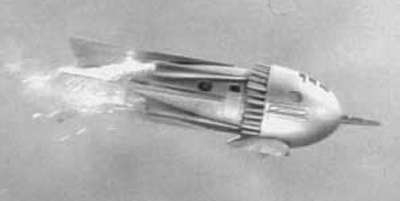
The Flash Gordon Prototype (Flew about as well as the stage models too).
The flash gordon space rocket amazed the children in the 1940's and 50's shot in black and white (Colour Film was yet to be invented) and watched all over the country on saturday mornings in local cinemas. (Pre-Television) - The original low budget theatre.
|
|||||||